


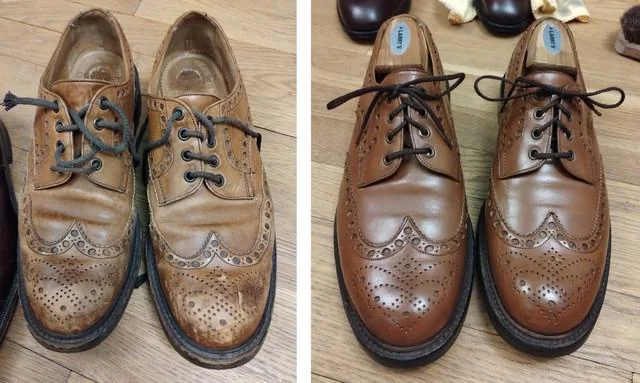
Cracked Leather Footwear: Condition Surfaces Before Damage Spreads
Cracked leather footwear often starts with dryness, repeated flexing, dirt buildup, or long periods without conditioning. Fine surface lines may be manageable, but deep cracks represent actual damage to the leather fibers and cannot simply be erased with polish.
The practical goal is to clean the surface gently, restore appropriate moisture, and prevent existing weak areas from becoming worse.
Identify Dryness Before Treating the Shoe
Inspect the leather under good light. Dry leather may look dull, feel stiff, and show small lines around areas that bend during walking.
Deep splits are different. If the surface has opened and the material beneath is visible, conditioner can improve surrounding leather but won’t permanently fuse the damaged fibers back together.
Check the Care Label and Finish
Not all leather footwear has the same finish. Smooth leather, suede, nubuck, coated leather, and synthetic materials require different care.
Before using any product, test a small hidden area. People may discover new shoe ideas through fashion-focused browsing, but the material description supplied by the shoe manufacturer should guide the care method.
Clean Before Applying Conditioner
Conditioner works best on a reasonably clean surface. Remove loose dust with a soft brush or dry cloth before adding moisture or cleaning products.
For compatible smooth leather, use a cleaner intended for the material and avoid soaking the shoe. Let the surface dry naturally away from direct heaters before conditioning.
| Condition | Care Approach | Avoid |
|---|---|---|
| Light dust | Soft brush or cloth | Aggressive scrubbing |
| Dry smooth leather | Suitable conditioner | Heavy saturation |
| Deep cracking | Protect surrounding area | Expecting full repair |
| Wet footwear | Slow air drying | Direct intense heat |
Apply a Thin, Even Layer
Use a small amount of leather conditioner rather than coating the shoe heavily. Work it over compatible smooth leather with a clean cloth, paying attention to flex points without flooding seams.
If the shoes form part of carefully planned layered wardrobe combinations, remember that conditioning can temporarily deepen the leather’s appearance. A hidden-area test is useful when preserving a particular finish matters.
Allow the product to absorb according to its directions, then remove excess residue if required.
Reduce the Stress That Caused the Cracks
Conditioning helps maintain leather, but prevention also depends on storage and wear. Shoes repeatedly bent in the same place, dried beside heaters, or stored while dirty can deteriorate faster.
Use shoe trees or gentle internal support when appropriate, and give damp footwear time to dry before wearing it again. Anyone exploring traditional footwear styling should also remember that older-looking leather still needs routine care; a worn aesthetic and neglected material aren’t the same thing.
Rotate pairs when possible so leather has time to recover between uses.
Where Leather Care Can Fail
More conditioner isn’t automatically better. Excess product can leave leather greasy, alter its appearance, collect dirt, or create buildup depending on the finish.
Another common mistake is trying to repair deep cracking with repeated coats of polish. Polish can improve color and shine, but it doesn’t rebuild broken leather fibers. If cracking is structural or located where the shoe flexes heavily, professional repair or replacement may be more realistic.
Frequently Asked Questions
Can cracked leather shoes be fully repaired?
Fine dryness lines can often be made less noticeable through proper cleaning and conditioning. Deep cracks involving broken leather fibers generally cannot be restored to completely undamaged condition, although a repair professional may improve their appearance.
How often should leather footwear be conditioned?
There is no universal schedule because climate, wear frequency, leather type, and product formulation differ. Inspect the leather periodically and condition compatible material when it begins feeling dry rather than applying product automatically every few days.
Can heat help leather conditioner absorb faster?
Direct heat is a poor shortcut because excessive drying can make leather more brittle and worsen existing damage. Let cleaned or conditioned footwear rest at normal room conditions unless the care-product manufacturer gives different instructions.
Protect the Leather Before Cracks Deepen
The best time to care for leather is while dryness is still superficial. Remove dirt gently, use a conditioner appropriate for the exact finish, let the shoes dry naturally, and avoid heavy product buildup.
Once cracked leather footwear develops deep splits, maintenance becomes damage control rather than true restoration. Regular light care is far easier than trying to rescue neglected leather later.






Leave a Reply