


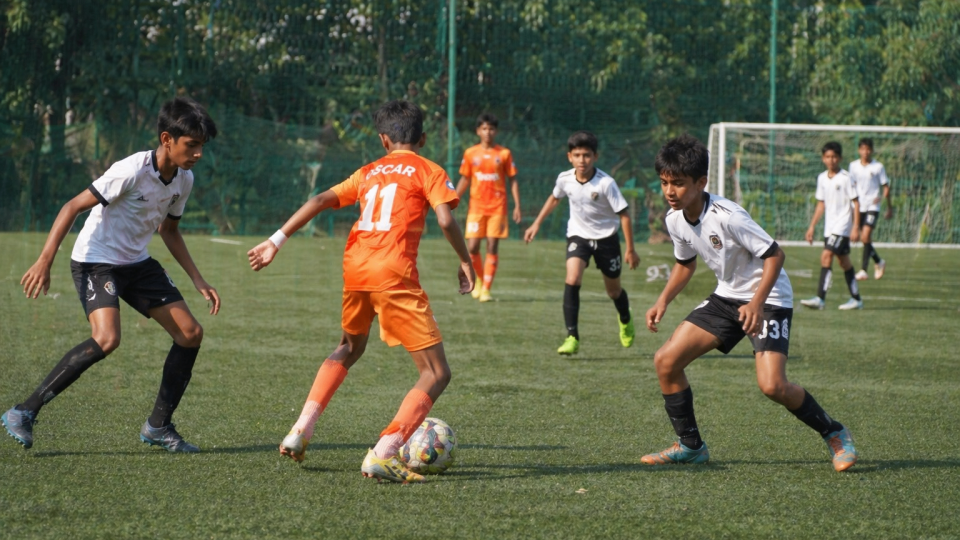
Weak Pressing Structure – Coordinate Movement Before Chasing Possession
Pressing fails when several players run toward the ball without controlling the space around it. Effective pressure requires coordination: one player approaches the ball carrier while teammates block passing options, cover nearby spaces, and prepare for the next pass.
Running harder isn’t always the answer. Moving together is.
Decide Who Starts the Press
A team needs clear pressing triggers so multiple players understand when to move. A poor touch, backward pass, slow square ball, or receiver facing their own goal can all create opportunities.
Once the nearest player commits, teammates should react immediately. Delayed support leaves easy passes around the first defender.
Teams exploring coordinated football play can focus on the connection between individual movement and collective spacing. One energetic press means little if the rest of the team stays disconnected.
Approach at the Right Angle
The first defender shouldn’t always run directly toward the ball. A curved approach can block one passing lane while still applying pressure.
That forces the opponent toward a more predictable area.
Keep the Lines Connected
If forwards press while midfielders remain deep, opponents can simply pass into the space between them. The defensive unit must move forward together.
Distances depend on the game situation, but the principle remains consistent: pressing players need support behind them.
Watching different competitive football environments can help illustrate why compactness matters. Opponents become harder to trap when they have large spaces between defensive lines to receive and turn.
| Pressing Error | What Opponents Gain | Better Response |
|---|---|---|
| One player presses alone | Easy spare pass | Move as a unit |
| Straight approach | Multiple exits | Curve the run |
| Midfield stays deep | Space between lines | Step forward together |
| Everyone attacks ball | Free far-side player | Protect weak side |
Cover the Next Pass
Pressing isn’t only about the player nearest the ball. Supporting defenders should anticipate where the opponent wants to play next.
One midfielder may mark a central option while another protects the passing lane behind the press. The back line can step higher if pressure on the ball is secure enough.
Players studying pressing and tactical structure can examine how pressure, cover, and balance work together. Removing several options at once makes the ball carrier’s decision more predictable.
Where Pressing Systems Break
Aggressive pressing can create serious problems when players chase without reading teammates. One unnecessary sprint may open the exact passing lane the team wanted to close.
Another mistake is pressing continuously regardless of fatigue or field position. Sometimes dropping into a compact block is the better decision.
Communication also matters. Short calls such as “step,” “hold,” “left,” or “screen” can help teammates coordinate without long explanations during play.
Practice the Press as a Unit
Pressing drills should involve several connected players rather than only 1v1 pressure. A 4v4 or 5v5 directional game gives players repeated chances to recognize triggers and support each other’s movement.
Coaches can reward regaining possession within a few seconds after a clear pressing trigger, but the quality of the structure should matter more than reckless speed.
Freeze moments can also help. Showing players the open passing lane often teaches more than repeatedly telling them to work harder.
Frequently Asked Questions
What is a pressing trigger in football?
A pressing trigger is a situation that signals a good moment to apply coordinated pressure. Examples can include a poor first touch, a backward pass, a slow pass toward the sideline, or a receiver with limited forward options.
Why does high pressing leave teams exposed?
High pressing becomes risky when defensive lines separate or players fail to cover passing lanes. If the opponent breaks the first wave of pressure, large spaces may appear behind the pressing players.
Should every player press the ball?
No. Usually one player directly pressures possession while others provide cover, block passing routes, track opponents, or protect spaces that could become dangerous if the press is beaten.
Press Together or Don’t Press Yet
A useful press is a coordinated attempt to control the opponent’s choices, not a race toward the ball. Establish clear triggers, improve approach angles, keep the team compact, and train supporting players to anticipate the next pass. Once those movements become connected, pressing becomes more controlled and much harder to play through.


Leave a Reply